
THE FOOD NOISE NOBODY TALKS ABOUT
How celiac disease, social anxiety, and an eating disorder slowly changed my relationship with food.
“The Food noise hears everything.”
Last week, I wrote about summer bodies.

This week, I want to talk about something a little less visible.
The food noise.
Not hunger.
Not cravings.
The constant chatter about food, weight, bodies, rules, guilt, and worthiness that can take up so much space in our minds.
For me, it started with a diagnosis.
Seventeen years ago, I found out I had celiac disease.
At first, I was grateful.
After years of feeling awful, removing gluten from my diet helped me feel better. Physically, it was a gift.
No more running to the bathroom with explosive diarrhea.
I know… not exactly the glamorous part of the story, but we’re friends here.
If you’ve ever seen Bridesmaids, you know the scene.
“You’re really doing it, aren’t ya? You’re shittin’ in the street.”
Thankfully, I never actually did that.
But my friend Steph can absolutely vouch for the fact that I once clogged her toilet and caused it to overflow. She ended up cleaning up the mess.
Now that’s a true friend.
And honestly?
Those are the not-so-darlin’ parts of life nobody puts on Instagram.
The clogged toilets.
The digestive disasters.
The moments that are embarrassing, inconvenient, and anything but graceful.
But if you’ve been hanging around here for any length of time, you know I don’t believe life has to be perfect to be meaningful.
In fact, some of the most human parts of our stories are the ones we’d rather hide.
The not-so-darlin’ parts.
And as it turns out, this diagnosis would eventually lead me into one of the biggest not-so-darlin’ chapters of my life.
Sure, finding gluten-free food was difficult back then. There weren’t many options. Most people had never even heard of celiac disease.
But after a couple of years, something else started happening.
The social anxiety crept in.
I wasn’t just avoiding gluten.
I was becoming painfully aware of how different I felt.
How different I had become.
WHEN FOOD BECOMES MORE THAN FOOD
Family dinners became stressful.
Thanksgiving.
Christmas.
Easter.
Birthday parties.
Barbecues.
Dinner invitations.
Every gathering seemed to come with questions.
“Why can’t you eat that?”
“Just one bite won’t hurt.”
“That must be terrible.”
“Don’t you miss it?”
God, if I had to explain it one more time, I thought I might scream.
And if I had to tell one more waiter I wasn’t ordering food only to have them repeatedly suggest a salad, I was going to lose my mind.
I remember sitting at a pizza place with a giant pizza sitting right in front of me.
Everyone laughing.
Eating.
Reaching for another slice.
And there I sat.
Watching.
Feeling left out.
Feeling angry.
Feeling different.
That’s when the voice started getting louder.
The one that whispered:
“You don’t need that anyway.”
“Look how good you’re doing.”
“That’s just junk food.”
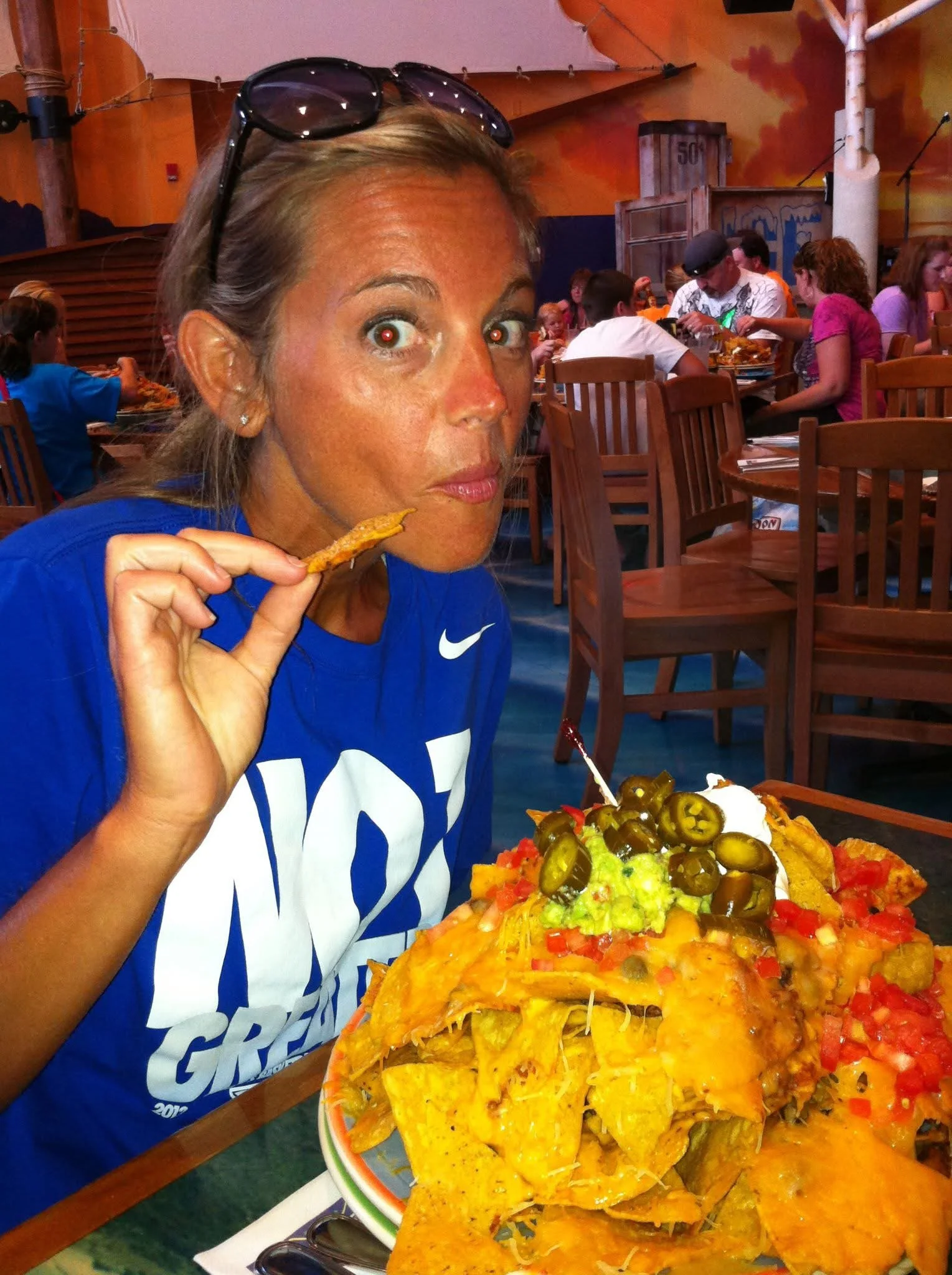
Panama City Beach, Florida — 2012. My first time eating gluten-free nachos at Margaritaville. A moment that felt surprisingly big at the time. Not just because of the food, but because it represented finding a small sense of normalcy in a world that suddenly felt very different.
I remember my 40th birthday.
I told my friends I didn’t want a cake.
Not because I didn’t deserve one.
Not because I didn’t want to celebrate.
I simply didn’t want to deal with it.
They insisted.
And while they thoughtfully brought me gluten-free cookies, they also bought a birthday cake everyone else could enjoy.
The cookies were kind.
But if you’ve lived with food restrictions, you know what I mean when I say it wasn’t quite the same.
So I smiled.
I sang.
I watched everyone eat my birthday cake.
And I realized just how much had changed.
Sometimes grief doesn’t look like tears.
Although there were tears that night too.
I remember thanking everyone for coming and feeling emotional for reasons I couldn’t fully explain.
Two friends I had experienced a painful falling out with were there that night. We had mended the friendship, but it was never quite the same.
If you’ve ever lost a friendship, you know what I mean.
Sometimes relationships come back together differently.
The closeness changes.
The ease changes.
The trust feels different.
That season of my life left a mark on me.
For a long time, it reinforced the belief that something must be wrong with me.
That I wasn’t enough.
That I had somehow failed.
One day I’ll write more about that story.
But not today.
Some wounds become scars.
They heal, but they remain visible.
And that night, sitting at my own birthday party, watching everyone enjoy a piece of cake I couldn’t eat, all of those feelings seemed to collide at once.
Sometimes grief doesn’t look like tears.
Sometimes it looks like sitting at a table full of people you love and still feeling the ache of everything that’s changed.
What began as managing a medical condition slowly became something much more complicated.
The food restrictions that were necessary for my health started blending with thoughts that had nothing to do with health at all.
And before I realized it, I was struggling with something much bigger than celiac disease.
Anorexia nervosa, to be exact.
THE GRIEF NOBODY TALKS ABOUT
What many people don’t understand is that food noise isn’t always about wanting to be thin.
Sometimes it’s about control.
Sometimes it’s fear.
Sometimes it’s anxiety.
Sometimes it’s grief.
Grief for what your life used to look like.
The late-night drive-thru runs with friends
The spontaneous ice cream stops.
Sharing a treat with your son.
The simple joy of not having to think about every single thing that goes into your mouth.
Sometimes it’s simply being exhausted from having to think about food all the damn time.
THE COMMENTS
People love to comment on food.
I once watched someone put a giant spoonful of margarine on a roll before looking at my plate and saying:
“You’re eating rabbit food.”
Others told me they felt sorry for me.
They’d tell me how awful my life must be.
They’d tell me they could never be gluten-free.
As if that was somehow helpful.
The worst part was bringing my own food while everyone else enjoyed their meal.
I always felt like I was center stage.
A spotlight shining directly on me.
Cue 2Pac’s All Eyez on Me.
Living life as a gluten-free thug.
A room full of people eating, yet somehow I felt like all eyes were on me.
They’d analyze what I was eating.
Or not eating.
What most people don’t realize is that comments about food can be incredibly triggering for someone struggling with an eating disorder.
Even years later.
The food noise hears everything.
And that voice?
That MF never seems to completely die.
It just gets quieter.
WHY I DON’T TRUST RESTAURANTS
These days, I don’t enjoy going out to eat.
Not because I don’t want to.
Because I don’t trust it.
My faith in restaurants has been shaken too many times.
One of my best friends worked in a restaurant that labeled menu items as gluten-free.
The problem?
They weren’t actually gluten-free.
The fryer grease had simply been switched from one fryer to another.
Cross-contamination was happening constantly.
Customers believed they were safe.
They weren’t.
Experiences like that change you.
They make you hypervigilant.
They make you question things.

They make food feel less like nourishment and more like a potential threat.
And when you’re already vulnerable to disordered eating, that’s a dangerous combination.
RECOVERY ISN’T A PERFORMANCE
One thing you’ll never see from me is a post showing every meal I eat in a day as proof of recovery.
Recovery isn’t a performance.
What I eat may not be what works for you.
As someone living with celiac disease, there are foods I simply cannot eat.
That doesn’t make me more recovered.
It doesn’t make me less recovered.
It simply makes me me.
I also struggle with the word recovered.
It sounds so final.
Like you’ve crossed a finish line.
Like the thoughts disappear.
Like you’ve reached some magical destination.
That hasn’t been my experience.
What I know is this:
Life gets bigger.
The voice gets quieter.
The space between the thoughts grows wider.
Healing becomes less about food and more about living.
One of the hardest parts of my own journey was attending group therapy as a middle-aged woman.
I was often the oldest person in the room by twenty years.
As a mother, all I wanted to do was take care of the younger women sitting beside me.
I wanted to tell them they were enough.
I wanted to protect them.
I wanted to mother them.
What I eventually realized was that I needed to learn how to offer that same compassion to myself.
And maybe that’s what healing really is.
Not perfection.
Not arrival.
Not having everything figured out.
Just learning to sit beside yourself with a little more kindness.
To stop treating yourself like the enemy.
To stop believing every thought.
To stop measuring your worth by your body or what’s on your plate.
YOU ARE NOT ALONE

If you’re reading this and struggling, I want you to know something.
You are not weak.
You are not failing.
You are not too old.
You are not the only grown woman quietly carrying this battle.
There are more of us than you realize.
Women raising children.
Women building careers.
Women caring for aging parents.
Women who appear to have it all together.
Women who don’t.
Women carrying shame they rarely speak out loud.
Women desperately wishing someone would understand.
I see you.
Because I’ve been you.
NEED A LITTLE EXTRA SUPPORT?
I created a meditation called Nourish the Soul: A Meditation for Eating Disorder Recovery.
Not because I have all the answers.
But because I understand the loneliness.
The guilt.
The fear.
And the hope.
If you need a little extra support today, I hope it offers you some comfort.
From my heart to yours, darlin’,
Tonya
Next week, I want to talk about the words. The comments. The names. The assumptions people make about bodies they know nothing about.
Because sometimes the deepest wounds aren’t caused by food at all.
They’re caused by the words.